



Host Family or Share House in Tokyo? A Comprehensive Comparison of Study Abroad Accommodation
Category: Information
Host Family or Share House in Tokyo? A Comprehensive Comparison of Study Abroad Accommodation
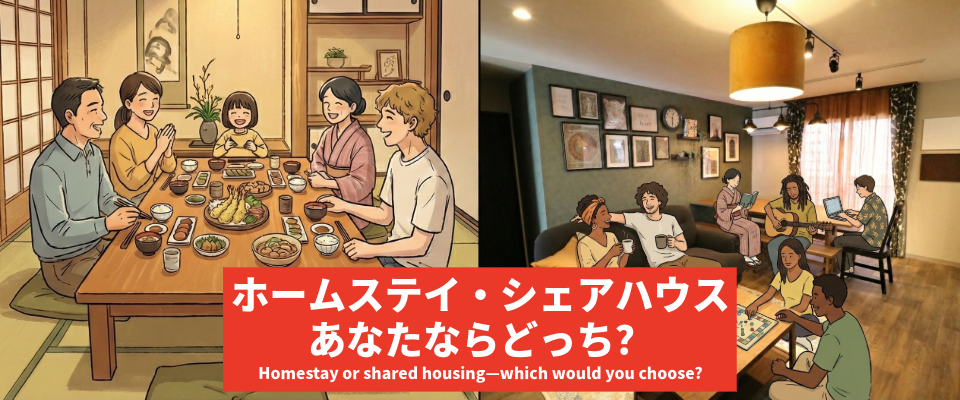
Congratulations to everyone who has decided to study abroad in Tokyo!
Along with “Which Japanese language school should I choose?”, an equally—or perhaps even more—challenging question is likely
“Where should I live in Tokyo?”
Living with a “Tokyo Host Family,” in particular, is a precious experience unique to Japan and a dream for many international students.
However, many people also think, “The freedom of life in a share house is hard to give up…”
We, Kudan Institute of Language & Culture, are
“Life Support Professionals”who have supported international students from over 70 countries in Suidobashi, Tokyo, for more than 30 years.
In this article, we will focus on “Host Families” and “Share Houses,” providing a thorough, multi-faceted, and honest comparison of the pros and cons of each for international students.
By the time you finish reading this article, you will surely find the accommodation that “truly fits” your study abroad style.
Which is Your Study Abroad Style? Determining the “Core” of Your Accommodation Choice
The most important thing when looking for a place to stay during your studies is whether it matches your “purpose for studying abroad.”
-
“Person A”:
“This is my first time studying abroad. I want to improve my conversation skills as quickly as possible in a safe environment while being immersed in Japanese! I also want to experience real Japanese culture and home cooking.”
→ A “Host Family”is strongly recommended.
-
“Person B”:
“It’s my second time living in Japan. I want to live at my own pace. I want to live in a convenient location near the school without being bound by curfews or rules, and enjoy cooking for myself and spending time with friends.”
→ A “Share House”might be the right fit.
Which type are you closer to?
Now, let’s look at each option in detail.
Thorough Explanation ①: [Cultural Experience & Peace of Mind] Host Family (Homestay)
A Host Family (Homestay) is a style of living where you become a member of a general Japanese family that has undergone screening and training.
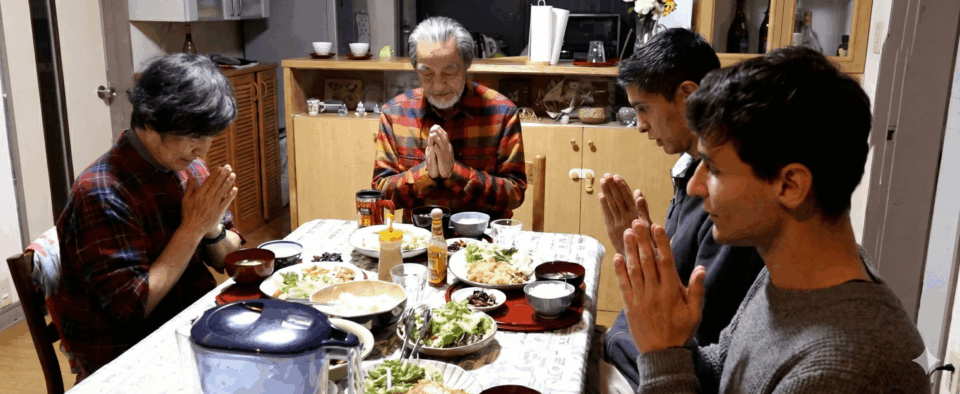
■ The Appeal of a Host Family (Pros)
Your Japanese WILL Improve
This is the greatest benefit.
You can “try out” the grammar and vocabulary you just learned at school with your host family at dinner that same day. Your host family will gently correct your mistakes, not as your “teachers,” but as your “family.”
Comparing time spent watching TV alone in an apartment versus time spent desperately trying to talk about “what happened today” in Japanese around the dinner table with a host family… it is obvious whose Japanese will have improved more after a few months.
Experience “Real Japanese Culture and Life”
Real Japanese culture is found not in textbooks or tourist spots, but inside the “home.”
Japanese home cooking (mom’s taste), seasonal events (New Year’s, Setsubun, Tanabata, etc.), the strictness of garbage separation, how to use the bath—you can experience “living culture” every day precisely because you are living together. This will become a lifelong asset for you.
The Highest Level of Security: A “Tokyo Family”
Living alone in an unfamiliar foreign country. What if you get sick? What if there is an earthquake?
Imagine being all alone in an apartment at such a time… If you have a host family, you have a “Tokyo family” right there who will immediately help you and ask, “Are you okay?” This mental peace of mind is irreplaceable.
Furniture & Meals Included! No Worries About Procedures or Cooking
- Meals Provided: Breakfast and dinner are provided on weekdays, and 3 meals on weekends/holidays, so there is no need to cook for yourself, and nutritional balance is perfect.
- Zero Initial Costs: High initial costs such as security deposits, key money, and brokerage fees are not required.
- Zero Life Preparation: Furniture, Wi-Fi, and bedding are all provided. You can start a comfortable life from day one with just a single suitcase.
■ Points to Consider with a Host Family (Cons)
Necessity to Follow Family “Rules”
You are a “guest” but also a “family member.” Naturally, you need to follow the rules of the house.
- Curfew: Many families have a curfew (a rule against coming home late at night) for dinner time and safety.
- Bath and Laundry Times: Since these are shared with the family, you may not be able to use them freely whenever you like.
- Inviting Friends: Basically, you cannot freely invite friends to the house.
Commuting May Take Time
Most families in Tokyo who own a “detached house with a garden” live in the “suburbs,” a bit far from the city center. Therefore, it is common for the commute to school (Kudan Institute is in Suidobashi, the very center of Tokyo) to take 40 to 60 minutes by train (during rush hour).
Adjusting Meals and Lifestyle
You eat what the host family cooks. For those who are picky eaters or do not want to eat at set times, it might feel a bit restrictive. (*Allergies and religious dietary restrictions are, of course, arranged in advance.)

Thorough Explanation ②: [Freedom & Independence] Share House / Guest House
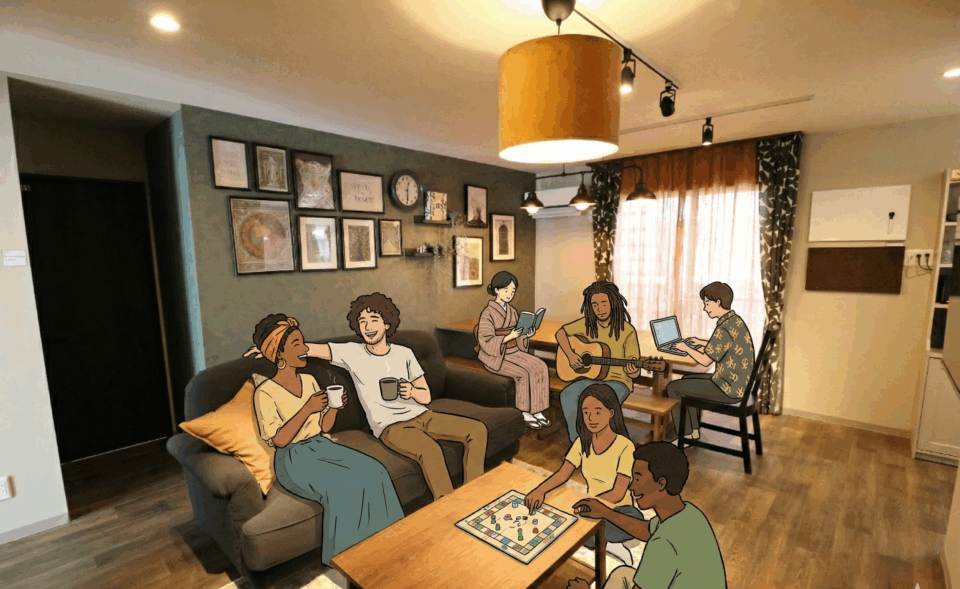
This style is for people who want to lead a free study abroad life at their own pace.
- Share House/Guest House: You have your own private room and share common areas like the kitchen, living room, shower, and toilet with other residents.
■ The Appeal of Share Houses, etc. (Pros)
No Curfew! Overwhelming “Freedom”
The biggest benefit is “freedom.”
- No Curfew: You can hang out with friends until late at night, work part-time, wake up when you like, and come home when you like.
- Your Own Pace: You can decide everything yourself, including when to eat and when to study.
- Inviting Friends: (Depending on the rules) It is generally easier to invite friends over compared to a host family.
Choosing a “Convenient Location” Near School
While host families are often in the suburbs, it is easier to choose a share house or apartment in a convenient location near the school (e.g., within 40 minutes of Kudan Institute). A short commute significantly improves your quality of life (QOL) and saves on transportation costs.
“Flat Encounters” with Diverse People
Share houses are home to people with various backgrounds, including Japanese students, working adults, and international students from countries other than your own. You can expect encounters as “flat friends,” different from a host family relationship.
Enjoy Cooking for Yourself
You can cook what you like, when you like. This is perfect for those who “want to learn how to cook in Japan” or “want to serve their own country’s cuisine.”
■ Points to Consider with Share Houses, etc. (Cons)
Japanese Improvement Depends on “You”
What happens if the residents of your share house are all international students from other countries or Japanese people who can speak English?
You might unconsciously choose the “easy language” (= English or your native language), and as a result, end up saying, “I didn’t speak any Japanese outside of school…” Japanese improvement depends on your strong will and effort.
Everything in Life is “Self-Responsibility”
- Meals, Cleaning, Laundry: You have to manage everything yourself. Even if you are tired from studying and part-time work, no one will cook for you.
- Dealing with Trouble: When you get sick or have trouble with neighbors, you have to resolve everything yourself, which can be very stressful.
Stress of Communal Living
This is a problem specific to share houses. Dirty kitchens, noise late at night, missing shared items… communal living with others always comes with stress.
High “Initial Costs” and “Complex Contracts”
Especially when renting an apartment, you may need high initial costs equivalent to 4-6 months’ rent, such as “security deposit,” “key money,” “brokerage fee,” and “guarantor” fees in Japan, and the procedures are very complicated.

If You Are Unsure, Please Consult “Kudan Institute”

“Both have pros and cons, and now I’m even more confused…”
“I’m interested in a host family, but I’m worried if there’s a family that suits me…”
At times like this, please rely on our
“Study Abroad Support Desk”at Kudan Institute of Language & Culture.
We never force a specific accommodation method on you. Our job is to listen to your purpose of “why you came to Japan” and find the optimal “foundation for living” together with you to achieve that goal.
A Dedicated Coordinator Proposes a Plan “Just for You”
Our school has dedicated coordinators who specialize in arranging accommodation.
We will give you advice from a professional perspective based on the course you are applying for (e.g., a host family for the “Conversation Course,” or a share house for the “Job Seeking Course” if you want to balance it with a part-time job), as well as your personality, budget, and goals in Japan.
All Accommodations are “Safe”
Both the host families we introduce and the share houses we partner with are exclusively properties and families that we have confirmed to be
“places where international students can live safely and with peace of mind.”
You do not need to make dangerous contracts with unknown real estate agents on the internet by yourself.
Extensive “Life & Career Support” Continues After Enrollment
Our support doesn’t end once you find a house.
The real work begins after your life here starts.
- “I don’t know how to put out the trash.”
- “I’m anxious about changing trains.”
- “I want to find a part-time job” or “I want to go to a Japanese university.”
School staff will support not only your studies but your entire life in Tokyo.
Summary: Choose a “Home” That Makes Your Study Abroad Experience the Best
Life with a
“Tokyo Host Family”is the most intense study abroad style that will dramatically improve your Japanese skills and give you a deep understanding of Japanese culture and the lifelong treasure of a “second family.”
Life in a
“Share House”teaches you freedom, independence, and the joy of designing your life in Tokyo at your own pace.
Neither one is “correct.”
It is about which one fits
“your purpose for studying abroad.”
Your choice will determine your study abroad life and your future.
Let’s design the most fulfilling Tokyo life together with us at Kudan Institute of Language & Culture!
▼For individual consultations and inquiries, click here

関連投稿:








タグ: English